This was scheduled to be published 5/25 and it didn't happen
In short form, a landrace is a locally adapted variety of a plant, often a food plant. Up until the advent of "perfect" food requirements in grocery stores, landraces were the norm rather than the exception. Farmers would trade seeds, knowing from experience that different varieties made for stronger plants.
Over generations, much of that landrace heritage has been lost, to the point that most people believe hybrids to be bad or weak. We plant one variety of squash, one variety of tomato, one variety of beans, and then when the circumstances aren't precisely right for that plant it dies or doesn't produce. This is the plant kingdom's version of siblings marrying generation after generation after generation. Of course the genetics are going to be weak.
With humans we accept the fact that inbreeding is a problem, but in our food we want stability and perfect taste, and we breed for those things. As variations are deliberately bred out of our crops, so are the abilities that made their ancestors thrive.
I've said before and I'll say it again (probably often) that I want strong, self sufficient monster plants that will spit "not good enough" back in my face and thrive in spite of my neglect. In order to do this we need to have variety in the plant genes. There have to be ancestors that thrived in desert conditions, ancestors that resisted insect attack, ancestors that have the perfect taste we love, etc. Over time it all comes together.
Last year I started a watermelon landrace, so this year I should get a bunch of first generation hybrids. Last year I ended up with four varieties of watermelon--Jubilee, Sugar Baby, Ali Baba, and an old variety that I've been growing for years. I have no idea what the ancestry is, so I just call it Traditional.
I pollinated a bunch of flowers, but only one survived (this is normal for watermelons). It was an Ali Baba female parent, crossed with Sugar Baby and Traditional. So this year I should get Ali Baba-sugar baby crosses and traditional-Ali Baba crosses. That being the case, I will not be planting Ali Baba, Sugar Baby, or Traditional. I will be re-planting Jubilee, but only as a pollen donor.
Three new varieties will be introduced into the landrace this year; Congo, Hopi Red, and Joseph Lofthouse Landrace. Congo I already have seeds for but it got eaten by bugs last year. Hopi Red (an established landrace) is drought tolerant, and the JLL includes hundreds of different varieties.
I will watch and see which plants the bugs and snails like, which take off and thrive in my yard, which shrivel at the first hint of cold, and probably about mid-June I'll cull the landrace patch to the strongest. I'll leave the Hopi Red, Congo and JLL--they will be pollen donors only, I won't be keeping seeds from them. The seeds will be taken from the Landrace watermelons that survive.
This is the "hybrid" year, working with first generation crosses of three heirloom varieties. 2019 will be the first year we start to see the results of true variety mixing, and first generation hybrids with the new varieties from 2018. 2020 should be the turning point with my watermelon landrace, meaning the point where I'll begin to see true adaptation to my environment, my water, my soil.
Friday, June 15, 2018

Tuesday, May 22, 2018
Garden Update
This year is a little different than last because I have the greenhouse. It seems to have moderated my planting addiction to a certain extent.
About mid-April I was thinking about planting watermelon at the beginning of May and went back to my records to see if that was too soon, only to discover that last year I planted them in March. MARCH!? There's snow on the ground in March! Good grief. So no, May is not too soon.
Greens are going full bore. They are naturalized in my garden and come up every year, although I'm not sure how that's going to work with the mulching schedule. Every 7 years each area of the garden will get a thick layer of leaves. So we'll see. Lots of salad! Radishes are also naturalized in the same area, and interestingly enough where those things are growing there are no weeds.
Beans are up. Hidatsu Red and Hidatsu Shield by the bean towers, two varieties of tepary beans by the fence. The tepary beans are a trial this year, a drought tolerant type of bean from the Southwest US. I planted the green beans two days ago and the dry beans yesterday. Kidney beans will also go by the fence, as they're supposedly a climber. 60% germination on that one so far, for beans purchased from the grocery store four years ago.
Watermelons were planted out last week.
Two Joseph Lofthouse winter squash in front beside the almond, along with a mystery squash that was a gift. One cantaloupe, also a gift, seems to be doing well. I planted more cantaloupe in the same area. Three zucchini are up under the walnut. The Black Beauty Zucchini don't seem to be germinating well. I planted more zucchini and yellow squash as a border around the new garden area.
On the east of the house is an area that has been designated as the "dry" garden for this year. The plan is to water it at most once a month during the summer. It's the start of developing drought tolerant varieties and learning about dry farming. Eleven seedlings up and starting to get secondary leaves.
About mid-April I was thinking about planting watermelon at the beginning of May and went back to my records to see if that was too soon, only to discover that last year I planted them in March. MARCH!? There's snow on the ground in March! Good grief. So no, May is not too soon.
Greens are going full bore. They are naturalized in my garden and come up every year, although I'm not sure how that's going to work with the mulching schedule. Every 7 years each area of the garden will get a thick layer of leaves. So we'll see. Lots of salad! Radishes are also naturalized in the same area, and interestingly enough where those things are growing there are no weeds.
Beans are up. Hidatsu Red and Hidatsu Shield by the bean towers, two varieties of tepary beans by the fence. The tepary beans are a trial this year, a drought tolerant type of bean from the Southwest US. I planted the green beans two days ago and the dry beans yesterday. Kidney beans will also go by the fence, as they're supposedly a climber. 60% germination on that one so far, for beans purchased from the grocery store four years ago.
Watermelons were planted out last week.
Two Joseph Lofthouse winter squash in front beside the almond, along with a mystery squash that was a gift. One cantaloupe, also a gift, seems to be doing well. I planted more cantaloupe in the same area. Three zucchini are up under the walnut. The Black Beauty Zucchini don't seem to be germinating well. I planted more zucchini and yellow squash as a border around the new garden area.
On the east of the house is an area that has been designated as the "dry" garden for this year. The plan is to water it at most once a month during the summer. It's the start of developing drought tolerant varieties and learning about dry farming. Eleven seedlings up and starting to get secondary leaves.
Friday, May 18, 2018
Dry Farming
This is my first year for a real dry farming test. Just briefly, dry farming is done in arid or semi-arid areas and does not require supplemental watering. It is considered dry farming if the farmer gets less than 20 inches of rain per year and does not use supplemental irrigation.
Not many do it anymore. Few ever did. But in a world of increasing weather tumult (hotter, colder, wetter, drier, storms more violent and frequent, etc) it seems to me that if we want to eat we need to relearn how to dry farm.
My area gets between 10 and 12 inches of rain in a normal year. Not a lot, but considerably more than some other areas. Still low enough that we're considered a desert.
I have selected several varieties of squash (pumpkin, butternut, spaghetti squash) that will be the basis of my first test. All three were planted last year in a dry area of the yard and still produced. Likely I will end up pulling out the pumpkins, as I inadvertently planted the same variety in another area. That leaves butternut and spaghetti squash, both winter squashes.
I planted six clusters of nine seeds, three seeds of each variety. I have watered them once since they were planted, and whatever comes up is my test for this year. The area is covered with leaves from last fall and will get no supplemental watering unless I do it. Two plants have come up already and I covered them to keep the birds off.
The goal is to water once a month, or less if it rains, so since it's raining today the next water schedule would be mid-June. Aside from testing the limits of dry farming, these plants are the start of my drought tolerant varieties. If I can get one fruit from each plant under those conditions, this is the 2nd year of that development.
I've said it before, but I want strong, self-sufficient monsters that will spit "not good enough" back in my face and thrive in spite of the conditions.
Original post on Dry Farming
2nd update
Not many do it anymore. Few ever did. But in a world of increasing weather tumult (hotter, colder, wetter, drier, storms more violent and frequent, etc) it seems to me that if we want to eat we need to relearn how to dry farm.
My area gets between 10 and 12 inches of rain in a normal year. Not a lot, but considerably more than some other areas. Still low enough that we're considered a desert.
I have selected several varieties of squash (pumpkin, butternut, spaghetti squash) that will be the basis of my first test. All three were planted last year in a dry area of the yard and still produced. Likely I will end up pulling out the pumpkins, as I inadvertently planted the same variety in another area. That leaves butternut and spaghetti squash, both winter squashes.
I planted six clusters of nine seeds, three seeds of each variety. I have watered them once since they were planted, and whatever comes up is my test for this year. The area is covered with leaves from last fall and will get no supplemental watering unless I do it. Two plants have come up already and I covered them to keep the birds off.
The goal is to water once a month, or less if it rains, so since it's raining today the next water schedule would be mid-June. Aside from testing the limits of dry farming, these plants are the start of my drought tolerant varieties. If I can get one fruit from each plant under those conditions, this is the 2nd year of that development.
I've said it before, but I want strong, self-sufficient monsters that will spit "not good enough" back in my face and thrive in spite of the conditions.
Original post on Dry Farming
2nd update
Friday, May 11, 2018
Spring is Sprung!
This year has been interesting, and it's barely started.
Most of the major projects are finished, now it's development time. The greenhouse, for example. This is the first summer with the greenhouse. I currently have three tomatoes, a zucchini and a few stalks of corn that will be in there all summer (I hope). The goal is to eventually have a "perennial" garden in the greenhouse that will produce 10 to 11 months of the year.
A few weeks ago I got some friends together and we pulled out the parkstrips. Grass is Gone for Good. :) They are now planted with perennials, and will be planted with drought tolerant annuals until I can propagate the larger plants needed to fill in. The goal there is to water twice a month or less, once everything is established.
All that grass is mounded up in the yard so I've been moving it a little at a time into other areas. I have a new "corner" garden on the southwest, and a new half-circle garden directly against the western (food) garden. In a year that grass will be composted and I'll be able to plant those areas.
All the main gardens have been transitioned to drip.
So lots of projects, lots of stuff going on, but the major infrastructure is complete. The only thing remaining is to remove all grass, which will be a long term process. Oh, and waiting for the trees to grow up. And getting all excited over my landraces. And rolling my eyes at the neighbors when they drive by and roll their eyes at my mess. They won't actually come talk to me, of course.
A few more weeks and the grass will be dealt with, which is the major mess right now. Just. Be. Patient.
Most of the major projects are finished, now it's development time. The greenhouse, for example. This is the first summer with the greenhouse. I currently have three tomatoes, a zucchini and a few stalks of corn that will be in there all summer (I hope). The goal is to eventually have a "perennial" garden in the greenhouse that will produce 10 to 11 months of the year.
A few weeks ago I got some friends together and we pulled out the parkstrips. Grass is Gone for Good. :) They are now planted with perennials, and will be planted with drought tolerant annuals until I can propagate the larger plants needed to fill in. The goal there is to water twice a month or less, once everything is established.
All that grass is mounded up in the yard so I've been moving it a little at a time into other areas. I have a new "corner" garden on the southwest, and a new half-circle garden directly against the western (food) garden. In a year that grass will be composted and I'll be able to plant those areas.
All the main gardens have been transitioned to drip.
So lots of projects, lots of stuff going on, but the major infrastructure is complete. The only thing remaining is to remove all grass, which will be a long term process. Oh, and waiting for the trees to grow up. And getting all excited over my landraces. And rolling my eyes at the neighbors when they drive by and roll their eyes at my mess. They won't actually come talk to me, of course.
A few more weeks and the grass will be dealt with, which is the major mess right now. Just. Be. Patient.
Friday, March 16, 2018
Bokashi (In a sense)
I decided to get rid of the compost pit, for a number of reasons. First, I'm trying to go no-till, and second...rats. A compost pile is really no better, and throwing away the food garbage is counter-productive.
Food waste has to go somewhere. It goes in the garbage and into a landfill, it goes down the disposal and into the water system, or it goes into the soil. Those are really the only alternatives.
Personally I'd prefer the soil.
So I started researching alternatives. One that I ran into was Bokashi.
Bokashi is an oriental system of food waste fermentation. You can spend a fortune on special Bokashi products, but at its core it's fermentation. An anaerobic process that turns organic matter into sludge.
Some people claim that fermentation is dangerous and should be avoided. Others say composting is unnatural and dangerous. Honestly, both have their place, and I'm beginning to think that this is one where fermenting might be a better option for my family.
The standard process is to put bokashi bran (bran treated with beneficial microbes) into the bokashi bucket and put food waste in on top. Then top the food waste with more bran. Keep packing the food waste in layered with bran, and when the bin is full set it aside and start another.
The fermentation process can take up to two months, but once the process is started it can sit there and stew in its own juices forever. When fully fermented, the bokashi can be buried in the garden (not near existing plants) to finish composting. One serious advantage of fermentation over composting is that you can use meat, eggs and dairy in bokashi. Because it's an anaerobic process, the aerobic microbes that make meat stink can't exist.
It's a good idea. I did some research, and it's not cost effective. Particularly for me, without a job.
Making the bran is relatively simple and cheap--beneficial microbes (which you can make from whey), molasses, wheat bran and water. But I don't have bran, and no way to buy it...
But if I can make the inoculant, why bother with the bran? The bokashi process is supposed to be a relatively dry process, but other things are fermented in water so why not this?
So I'm trying it. I have a big jug of inoculant (whey as a lactic acid starter culture and potato water as microbe food), and a couple 5 quart ice-cream buckets with tight fitting lids. I layer food from our garbage bucket, smash it down good, and pour the inoculant in on top. Then more garbage, more inoculant, until the bucket is full. Then set it aside and start another. The stuff makes its own liquid and stays mostly submerged.
Results:
The first bucket stank to high heaven. The food was already submerged in its own juice when I started, so there was little chance to inoculate. When I started I poured my "starter" culture over it, smashed it down and put the lid on. The bucket was already full, so I couldn't layer the starter with the ferment. The smell did not escape the bucket.
The second bucket has an odd sweet smell but doesn't stink. Not precisely the smell I'm used to for fermentation, but not unpleasantly "off" either. I was able to layer the starter with the ferment, since I started this bucket fresh.
The third bucket is in process. Powdered milk in the bottom (since the fermentation we're looking for is mostly lactic bacteria), then garbage, then powdered milk, then more garbage. Mashed down to create its own liquid and maintain the anaerobic environment needed for fermentation. I didn't even use the culture on this one, although I'll keep it for future tests.
Update (four months later)
Bucket 1 still stank when I buried it. This can be considered the "control" bucket since I didn't get a chance to inoculate.
Bucket 2 was moldy but didn't stink the same way. Buried it next to 1.
Bucket 3 was the first real success. I used layered powdered milk and garbage, no inoculant. It didn't stink and had no mold. Buried next to 2.
Bucket 4 same process as 3. Currently fermenting
Bucket 5 same process. Currently fermenting
Bucket 6 same process. Currently fermenting
Bucket 7 just started.
This seems to be working quite well. When a bucket is about three months old I take it outside and bury it in an unused area of the garden.
Food waste has to go somewhere. It goes in the garbage and into a landfill, it goes down the disposal and into the water system, or it goes into the soil. Those are really the only alternatives.
Personally I'd prefer the soil.
So I started researching alternatives. One that I ran into was Bokashi.
Bokashi is an oriental system of food waste fermentation. You can spend a fortune on special Bokashi products, but at its core it's fermentation. An anaerobic process that turns organic matter into sludge.
Some people claim that fermentation is dangerous and should be avoided. Others say composting is unnatural and dangerous. Honestly, both have their place, and I'm beginning to think that this is one where fermenting might be a better option for my family.
The standard process is to put bokashi bran (bran treated with beneficial microbes) into the bokashi bucket and put food waste in on top. Then top the food waste with more bran. Keep packing the food waste in layered with bran, and when the bin is full set it aside and start another.
The fermentation process can take up to two months, but once the process is started it can sit there and stew in its own juices forever. When fully fermented, the bokashi can be buried in the garden (not near existing plants) to finish composting. One serious advantage of fermentation over composting is that you can use meat, eggs and dairy in bokashi. Because it's an anaerobic process, the aerobic microbes that make meat stink can't exist.
It's a good idea. I did some research, and it's not cost effective. Particularly for me, without a job.
Making the bran is relatively simple and cheap--beneficial microbes (which you can make from whey), molasses, wheat bran and water. But I don't have bran, and no way to buy it...
But if I can make the inoculant, why bother with the bran? The bokashi process is supposed to be a relatively dry process, but other things are fermented in water so why not this?
So I'm trying it. I have a big jug of inoculant (whey as a lactic acid starter culture and potato water as microbe food), and a couple 5 quart ice-cream buckets with tight fitting lids. I layer food from our garbage bucket, smash it down good, and pour the inoculant in on top. Then more garbage, more inoculant, until the bucket is full. Then set it aside and start another. The stuff makes its own liquid and stays mostly submerged.
Results:
The first bucket stank to high heaven. The food was already submerged in its own juice when I started, so there was little chance to inoculate. When I started I poured my "starter" culture over it, smashed it down and put the lid on. The bucket was already full, so I couldn't layer the starter with the ferment. The smell did not escape the bucket.
The second bucket has an odd sweet smell but doesn't stink. Not precisely the smell I'm used to for fermentation, but not unpleasantly "off" either. I was able to layer the starter with the ferment, since I started this bucket fresh.
The third bucket is in process. Powdered milk in the bottom (since the fermentation we're looking for is mostly lactic bacteria), then garbage, then powdered milk, then more garbage. Mashed down to create its own liquid and maintain the anaerobic environment needed for fermentation. I didn't even use the culture on this one, although I'll keep it for future tests.
Update (four months later)
Bucket 1 still stank when I buried it. This can be considered the "control" bucket since I didn't get a chance to inoculate.
Bucket 2 was moldy but didn't stink the same way. Buried it next to 1.
Bucket 3 was the first real success. I used layered powdered milk and garbage, no inoculant. It didn't stink and had no mold. Buried next to 2.
Bucket 4 same process as 3. Currently fermenting
Bucket 5 same process. Currently fermenting
Bucket 6 same process. Currently fermenting
Bucket 7 just started.
This seems to be working quite well. When a bucket is about three months old I take it outside and bury it in an unused area of the garden.
Wednesday, March 7, 2018
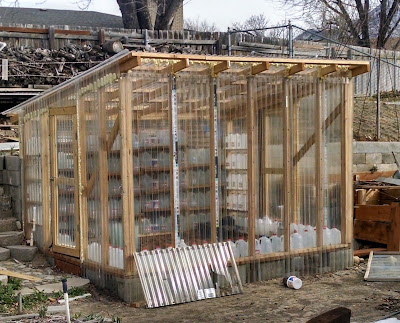
My GreenHOUSE!!! :)
I'm in love. Fresh greens in February, volunteer tomatoes, cilantro, a place for seedlings...

Friday, December 8, 2017
Greenhouse Update
Night-time temperatures are into the high teens, so I thought it was time for an update.
I finished sealing this week, although I still need to finish the waterwall. Currently that is half completed but there are two big water tanks and water bottles all around the outside.
According to my measurements, the greenhouse is holding a night-time temperature of about 15 degrees above the outside. When the temp outside is 19, the inside temperature is 32. Outside is 17, inside is 30, and so on. Not healthy for the more fragile plants, but still good. I'm hoping that the waterwall completion will bring that up by another five degrees.
However, I have noticed that the area near the block wall remains considerably warmer--when the water bottles by the glazing on the south were completely frozen, the big tanks in back by the wall weren't even slushy. The tomatoes back there are still alive, while the cilantro planted in front is struggling a lot.
I'm going to try to bring the tomatoes through the winter, just to see if it's possible. I'm getting a good idea of what's possible with this structure (for the winter, anyway) and it looks like we'll have a 10 to 11 month growing season. Which is exactly what I was hoping for. 12 month would be great, but no time for the structure to freeze off any bugs or mold. With a one month solid freeze, we should be able to reduce or eliminate year-round indwellers. :)
I knew that slanting the roof to the north would reduce the heat absorption to some extent--I actually wanted a more slanted roof, but got about a 10 degree slant. I was willing to trade off a little bit of winter growing time for (hopefully) less heat in the summer. We'll have to see on that one.
See the first greenhouse post here.
I finished sealing this week, although I still need to finish the waterwall. Currently that is half completed but there are two big water tanks and water bottles all around the outside.
According to my measurements, the greenhouse is holding a night-time temperature of about 15 degrees above the outside. When the temp outside is 19, the inside temperature is 32. Outside is 17, inside is 30, and so on. Not healthy for the more fragile plants, but still good. I'm hoping that the waterwall completion will bring that up by another five degrees.
However, I have noticed that the area near the block wall remains considerably warmer--when the water bottles by the glazing on the south were completely frozen, the big tanks in back by the wall weren't even slushy. The tomatoes back there are still alive, while the cilantro planted in front is struggling a lot.
I'm going to try to bring the tomatoes through the winter, just to see if it's possible. I'm getting a good idea of what's possible with this structure (for the winter, anyway) and it looks like we'll have a 10 to 11 month growing season. Which is exactly what I was hoping for. 12 month would be great, but no time for the structure to freeze off any bugs or mold. With a one month solid freeze, we should be able to reduce or eliminate year-round indwellers. :)
I knew that slanting the roof to the north would reduce the heat absorption to some extent--I actually wanted a more slanted roof, but got about a 10 degree slant. I was willing to trade off a little bit of winter growing time for (hopefully) less heat in the summer. We'll have to see on that one.
See the first greenhouse post here.
Subscribe to:
Posts (Atom)