This year is a little different than last because I have the greenhouse. It seems to have moderated my planting addiction to a certain extent.
About mid-April I was thinking about planting watermelon at the beginning of May and went back to my records to see if that was too soon, only to discover that last year I planted them in March. MARCH!? There's snow on the ground in March! Good grief. So no, May is not too soon.
Greens are going full bore. They are naturalized in my garden and come up every year, although I'm not sure how that's going to work with the mulching schedule. Every 7 years each area of the garden will get a thick layer of leaves. So we'll see. Lots of salad! Radishes are also naturalized in the same area, and interestingly enough where those things are growing there are no weeds.
Beans are up. Hidatsu Red and Hidatsu Shield by the bean towers, two varieties of tepary beans by the fence. The tepary beans are a trial this year, a drought tolerant type of bean from the Southwest US. I planted the green beans two days ago and the dry beans yesterday. Kidney beans will also go by the fence, as they're supposedly a climber. 60% germination on that one so far, for beans purchased from the grocery store four years ago.
Watermelons were planted out last week.
Two Joseph Lofthouse winter squash in front beside the almond, along with a mystery squash that was a gift. One cantaloupe, also a gift, seems to be doing well. I planted more cantaloupe in the same area. Three zucchini are up under the walnut. The Black Beauty Zucchini don't seem to be germinating well. I planted more zucchini and yellow squash as a border around the new garden area.
On the east of the house is an area that has been designated as the "dry" garden for this year. The plan is to water it at most once a month during the summer. It's the start of developing drought tolerant varieties and learning about dry farming. Eleven seedlings up and starting to get secondary leaves.
Showing posts with label Greenhouse. Show all posts
Showing posts with label Greenhouse. Show all posts
Tuesday, May 22, 2018

Wednesday, March 7, 2018
My GreenHOUSE!!! :)
I'm in love. Fresh greens in February, volunteer tomatoes, cilantro, a place for seedlings...

Monday, November 20, 2017
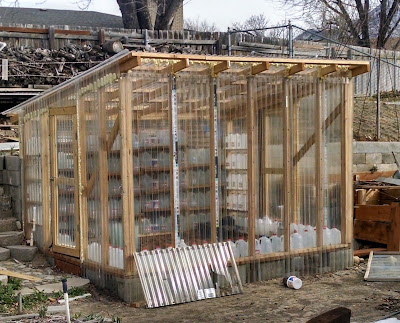
My greenhouse is up!
I've been planning this thing for years. It came together sllllooooowwwwwllllyyyyy, but with the help of some amazing friends, it's done!
The interior space is about 9x11. It backs onto a cinderblock wall with soil behind it. It has a door on east and west, in the direction of the prevailing winds. For temperature control it has a water-filled plant pot (the kind they grow trees in) in each corner. In future years those will be replaced with closed barrels so there's no problem with insects. Eventually it will have a waterwall against the cinderblock, made of gallon milk jugs filled with water. I started working on that piece today.
I had planned for the roof to slope sharply to the north (northern exposure) but it didn't work out that way. When greenhouses were invented, it was for areas with cool summers and frigid winters--the additional heat was very necessary, year round. People have continued to build that way, simply because it's traditional, but one of the main problems with greenhouses in more temperate areas is getting rid of excess heat.
The idea behind having the roof face north is that during the winter the greenhouse would receive full exposure on the front face, while during the summer it wouldn't hit any surface straight on, the roof not being angled correctly for sun exposure and the sun at a high angle so most of the light would also miss the front.
Because of some oops moments during construction the roof is angled north, but not sharply--perhaps a 10 degree slant. So rain runs off, but the sun will still hit it. I'm going to do an experiment during the summer and put a shade cloth over the roof, simulating what would have happened if the plan had remained as I originally had it. The water also runs off the back of the roof, into the forest garden area.
There will eventually be a small (1 foot wide) garden area immediately around the greenhouse to take advantage of the extended warm period.
Currently, when the greenhouse is not fully sealed and there is no waterwall in place:
Night-time temperatures: 8 to 10 degrees above outside
Day-time temperatures: 15 degrees above outside temps when cloudy, up to 40 above when sunny
So theoretically daytime temps could go down to 18 without too much risk of freezing. Night-time temps could go down to 22.
The tomatoes are still alive (if struggling). Cilantro is still alive. Greens are up and should be ready to start picking mid-December.
I've had several suggestions for additions and improvements, but for this first year I'm keeping it entirely passive. I want to know what the structure is capable of before I start making changes.
The interior space is about 9x11. It backs onto a cinderblock wall with soil behind it. It has a door on east and west, in the direction of the prevailing winds. For temperature control it has a water-filled plant pot (the kind they grow trees in) in each corner. In future years those will be replaced with closed barrels so there's no problem with insects. Eventually it will have a waterwall against the cinderblock, made of gallon milk jugs filled with water. I started working on that piece today.
I had planned for the roof to slope sharply to the north (northern exposure) but it didn't work out that way. When greenhouses were invented, it was for areas with cool summers and frigid winters--the additional heat was very necessary, year round. People have continued to build that way, simply because it's traditional, but one of the main problems with greenhouses in more temperate areas is getting rid of excess heat.
The idea behind having the roof face north is that during the winter the greenhouse would receive full exposure on the front face, while during the summer it wouldn't hit any surface straight on, the roof not being angled correctly for sun exposure and the sun at a high angle so most of the light would also miss the front.
Because of some oops moments during construction the roof is angled north, but not sharply--perhaps a 10 degree slant. So rain runs off, but the sun will still hit it. I'm going to do an experiment during the summer and put a shade cloth over the roof, simulating what would have happened if the plan had remained as I originally had it. The water also runs off the back of the roof, into the forest garden area.
There will eventually be a small (1 foot wide) garden area immediately around the greenhouse to take advantage of the extended warm period.
Currently, when the greenhouse is not fully sealed and there is no waterwall in place:
Night-time temperatures: 8 to 10 degrees above outside
Day-time temperatures: 15 degrees above outside temps when cloudy, up to 40 above when sunny
So theoretically daytime temps could go down to 18 without too much risk of freezing. Night-time temps could go down to 22.
The tomatoes are still alive (if struggling). Cilantro is still alive. Greens are up and should be ready to start picking mid-December.
I've had several suggestions for additions and improvements, but for this first year I'm keeping it entirely passive. I want to know what the structure is capable of before I start making changes.
Subscribe to:
Posts (Atom)