Showing posts with label dust mulch. Show all posts

Wednesday, August 8, 2018

Dry Farming update

This year I’ve been working on a number of projects, but because we live in a desert the water takes precedence.

One project that I was able to start this year is a dry garden.

Dry gardening (or dry farming) is the practice of planting and growing without water. Technically in order to be considered “dry” farming, the area has to get less than 20 inches of rain per year and the farmer doesn’t use supplemental irrigation.

Many areas considered “dry farming” areas leverage mild winters to plant winter crops, such as wheat, then let the land sit during the dry summer. Others plant in the summer but use mulch (often dust mulch), wide spacing, alternate year planting and other procedures to get a crop where none would otherwise grow.

I decided that for the purpose of this test I would water no more than twice a month, so it’s not technically dry by definition, but considering that the main garden gets watered every other day (more or less) every two weeks is a huge improvement.

Tucked between our house and the neighbor’s fence is a strip of dirt about six feet wide and 20 feet long. Nothing grows there, it’s in shade after about 3, it has grapevines on one side and the house on the other. The water source is our 275 gallon water tanks that collect water from the roof. The soil is sand and rock.

Call it a personal idiot-cyncracy, but I don’t like seeing dirt (not soil in this case) going unused. Since in many areas grapes aren’t watered at all, I figured it was both a good test for them and a good place to put a dry garden.

It gets about seven hours of sun. Last summer I dug down into it sometime in July and it was bone dry at least a foot down. Last fall I mulched it deeply, and this spring I planted through the mulch.

The bugs had a heyday, and all but one of the seedlings perished.


I planted again on 6/11, this time under cover. Milk jugs are incredibly versatile.


That same day I also planted a single zucchini plant / butternut combination in an area with the same circumstances but in full sun. Deeply mulched, same soil. I gave each seed 2 gallons of water.

On the same day that the picture above was taken, one month after planting...


It had no additional water—the only difference was the sun. That’s a castle block in the bottom corner, about 11 inches wide.

The dry garden was replanted on 6/11. The sun version was watered on 7/1 but probably could have gone longer. The shade version was watered for the first time on 7/9. They were all watered on 7/24 because I decided (erroneously, I now believe) that I should stick to the same watering schedule for both.

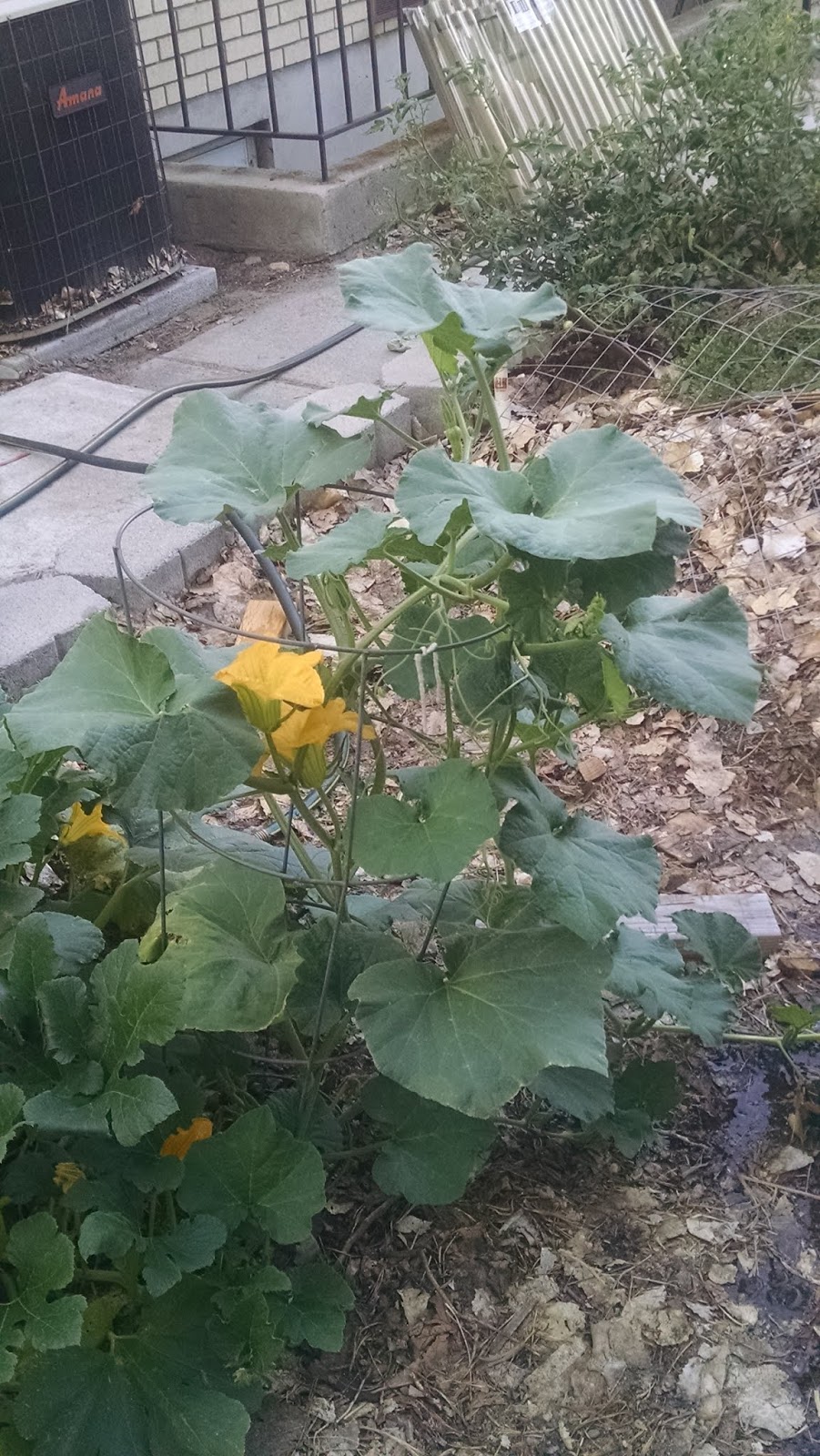
So the sun version was watered on 8/8. Today, we have this.


And this...


And then we have all the other plants in the dry garden. At least the grapes are thriving.


The one in the middle is another zucchini, of the same variety as the other.

The sun made a much larger difference than I expected. The sun garden needs to be protected during the worst of the afternoon heat, but the butternut has male blossoms and the zucchini is bearing, so the little bit of extra work is worth it.

Watering every two weeks is probably too much if you have good soil. My soil is sand and rock but I could probably still stretch it to once a month if necessary. The true test will be next year, when I use the seeds I get this year and stretch the watering schedule to once a month.

I figure if they survive and fruit under these conditions they’ll be better adapted in the next generation. The ideal would be to find varieties that are already adapted to drought conditions (massive root systems, primarily) and start from there.

I never could do anything the easy way.

The first update

The second update

Original post on Dry Farming

Friday, June 15, 2018

Dry Farming update

A month since I posted last about my dry-farming test.

As a refresher, I planted three kinds of seeds and then left them alone. They were planted under a thick layer of mulch in poor soil. I put them in an area with afternoon shade so they're protected from the worst of the heat.

The insects loved the buffet I put out for them. Of the seventeen plants that came up, only one survived. Once I realized the problem I tried to protect those that remained, but only one was able to recover. Lesson learned: put out bait or otherwise protect the seedlings until they're big enough to survive insect onslaught. In a dry environment insects will go after anything "wet," and in this case that's the seedlings.

A week or so ago I replanted, digging small pits to hold the seeds and setting topped milk bottles in the holes surrounded by soil to keep the insects out. So far six have sprouted, including one that came up from the original seeds. With the one remaining from the original planting we have a total of seven. I am expecting that more will come up in the next few weeks. Several are already getting their secondary leaves. I intend to leave them covered until they fill up the covers.

The next watering is planned for 7/1, since I watered the new plantings when I put the seeds in. I will only water if the soil appears to need it or the plants are seriously struggling. If the soil still appears wet at that time I will plan to water on 7/15, and so on.

The goal is to water twice a month at the most, hoping that I won't have to water at all (unlikely as that might be).

The first update

The second update

Original post on Dry Farming

Friday, May 18, 2018

Dry Farming

This is my first year for a real dry farming test. Just briefly, dry farming is done in arid or semi-arid areas and does not require supplemental watering. It is considered dry farming if the farmer gets less than 20 inches of rain per year and does not use supplemental irrigation.

Not many do it anymore. Few ever did. But in a world of increasing weather tumult (hotter, colder, wetter, drier, storms more violent and frequent, etc) it seems to me that if we want to eat we need to relearn how to dry farm.

My area gets between 10 and 12 inches of rain in a normal year. Not a lot, but considerably more than some other areas. Still low enough that we're considered a desert.

I have selected several varieties of squash (pumpkin, butternut, spaghetti squash) that will be the basis of my first test. All three were planted last year in a dry area of the yard and still produced. Likely I will end up pulling out the pumpkins, as I inadvertently planted the same variety in another area. That leaves butternut and spaghetti squash, both winter squashes.

I planted six clusters of nine seeds, three seeds of each variety. I have watered them once since they were planted, and whatever comes up is my test for this year. The area is covered with leaves from last fall and will get no supplemental watering unless I do it. Two plants have come up already and I covered them to keep the birds off.

The goal is to water once a month, or less if it rains, so since it's raining today the next water schedule would be mid-June. Aside from testing the limits of dry farming, these plants are the start of my drought tolerant varieties. If I can get one fruit from each plant under those conditions, this is the 2nd year of that development.

I've said it before, but I want strong, self-sufficient monsters that will spit "not good enough" back in my face and thrive in spite of the conditions.

Original post on Dry Farming

2nd update

Wednesday, August 30, 2017

Dry farming (in a sense)

I try to grow most of what we eat. There are a lot of reasons for this, many of them health related. Argue as you will, our water, air and soil is scarcely healthy and we add stuff to them that makes it worse. When I plant, I know precisely what is going into my plants, into my soil and into my mouth.

I can't grow it all at this point, but I'm working on what I can.

Part of the problem with growing in this area is water. I use far too much water for thirsty lawns (which will be going away at the first opportunity!). Other than that my major water use is for food producing gardens, fruit trees, and grape vines. Unfortunately, municipal water is well known for harboring such gems as pharmaceuticals, industrial byproducts and agricultural waste. Then there's the nasties that we ADD to the water to make it "Safe." Right.

The best option then, would seem to be to produce only what I can grow without municipal water. Or maybe not. That would be a yard full of sand and rock, basically. I've done work to make the area more self sufficient, but it works to a certain point and then I have to look for something else that take me that tiny step closer to my goal.

I started doing some research on dry farming, farming that relies only on the water available on a site rather than irrigation or municipal water. From my research it appears that dry farmers fit primarily into two categories.

1) Farmers who farm during the growing season in areas with high humidity, low seasonal temperatures, mild winters and deep, rich (primarily clay) soils. The information I've been able to find indicates that soil between 6 and 8 feet deep is ideal, deeper is better. It must be a mix of sand, clay and organic matter to hold the water with no impermeable or partially impermeable layers to stop water flow.

2) Farmers who leverage mild winters and plant their primary crop (often winter grains) when the rains are falling (September through May) then harvest in the spring. These farmers can grow on poor soils, have low humidity, but also low seasonal temperatures and mild winters with little or no snow.

I do not fit in either category. My soil is straight sand, with a layer of rock underneath. Temps consistently get up into the 100's in the summer and below freezing in the winter. On the other hand, I have grapevines and fruit trees that have thrived with little water for 30 + years, digging their roots deep. So it is possible.

Additional research brought up a third group, farmers who grow in arid to semi-arid lands, in areas that have harsh winters and brutal summers. In fact, the original definition of "dry farming" included only those areas that got less than 20 inches of precipitation per year. By this definition, #1 up above isn't dry farming, or only in the loosest sense, in that they do not use irrigation or municipal water.

So with dry farming defined, how do I use it?

The basic principles of dry farming seem to be:

Keep the water in the soil
Soil treatment
Choose crops that work
Plant drought tolerant varieties
Fallow season
Plant spacing

Water can be kept in the soil through a variety of techniques--mulching (either dust mulch, organic mulch, or rock mulch), covering the soil, shading the soil, controlling wind, and controlling temperature. Water primarily leaves by going up or down--evaporation or dripping down to the water table. By choice, if you must have one or the other, water table is probably best since the roots can chase it down. Evaporation can be used, providing you have sufficient ground cover to catch the evaporating water and return it to the soil. Ideally the soil should be a clay loam, but we're not doing "ideal" here. High organic matter is of utmost importance. If you start with poor soil, work to amend it until it can be used.

Soil is a loose web of particles of various sizes. Water is a perfect (liquid) crystaline matrix. Through adhesion it will try to fill the space with itself, climbing up through the soil if there is a path for it. That path is created by the density and makeup of the soil. By lightly packing the soil under a seed, you create the path for the water to fill that space, wetting the soil if there is any water in it. Traditional dry farming uses multiple implements to bring the water up from deep underground. It also pulverizes the soil on the surface to prevent evaporation in a sort of dry (or dust) mulch. Originally it appears that this process was used because organic mulches were not available in the areas where dry farming was pioneered. Even now, organic mulches on the scale required by a dry farm are impractical at best.

Choose crops that create a large root system. Many "modern" varieties have very little root, since they're intended to be grown under irrigation. Primary crops for dry farming must be able to chase the water, rather than having it come to them.

When you've chosen your crop, choose varieties that are specifically drought tolerant, and that doesn't mean drought tolerant under irrigation. If it can't thrive under those conditions, it doesn't deserve to be planted. Look for phrases like "prone to cracking" or "don't water too much" because these indicate a variety that may do better with less water. Heirlooms are likely to be more drought tolerant than "new" varieties.

In arid areas it is necessary to let the soil moisture build up over an extended period of time. Every other year planting is ideal, but at minimum every four to five years the soil should rest and collect water. Letting an area "lie fallow" also increases fertility, particularly if you cover crop or have animals on it during that period. Taking into consideration that a cover crop (according to the information I found) will use up part of your stored water.

And last, plant spacing. This seems to be key in dryland farming, and this is where I have the hardest time fitting my head around it. With the basic principles of dry farming, plants are to be given a great deal of space. The idea seems to be that with less competition the plant roots will spread further, with more space to take water from, and produce more. This may be the case. I don't know, as I've never tried it. I have a 30 x 50 foot garden and planting five or ten feet apart simply isn't practical. With pumpkins or other squash I can almost see it, since they spread to fill the available space. But corn? Beans? Tomatoes? Potatoes? In fact, the information I read said potatoes should be spaced even further apart than that. Supposedly, without the competition of other roots in "their" space, the plants have more available water in the soil.

I'm not sure this plant spacing business makes sense, but I'm going to try it next year in a small area and see what happens.

On my scale I have no problem finding organic mulching materials, and dust mulch might as well be Santa Claus since I have no clay in my soil. I can plant under and around trees, create windbreaks, and plant in partial shade. I have plants I think will work for waterless planting and I'm going to try deep watering, watering through a pipe to force the plants roots deep.

Every outside input becomes a handicap if it's ever unavailable. Right now that means I need water independence, so that is what I'm working toward. Maybe it'll never happen, but each failure and success brings me closer to the ideal.

First Update

Second Update