I mentioned in an earlier post that the celery was a wash. I planted a whole bunch (in moss, sheltered, under grow lights) and not a single one came up.
Thinking my seeds were perhaps to blame, I did a germination test. I scattered a pinch of seeds in a plastic bag on a wet paper towel. It took a while, but every single silly seed sprouted. It was like the celerypocolypse, with zombie celery popping up everywhere.
Celery is notoriously picky, and if I manage to grow this stuff I only want the strongest. I want the plants that will spit "not good enough" back in my face and grow in spite of my neglect. I stripped the seedlings from the paper towel with my fingers, scraped them all up and unceremoniously dumped them into the moss where I tried to start seedlings the first time. They did OK, a little yellow. When they had seed leaves I took them out of the moss and plunked them in the dirt.
So far, so good. I can see half a dozen that are sinking their roots into the dirt and laughing at my attempts to kill them. This is good. I'll try harder next time. :)
Monday, March 20, 2017

Monday, March 13, 2017
The effectiveness of a pinned post
I have one post (on vinegar craving) that still gets about 200 hits per week after five years. I can see that the posts to either side of it get more hits than most of my other posts, but few people go so far as to search out the homepage and see what I'm currently writing.
So I did a test. For three days I "pinned" the vinegar craving post, just to see if there was a difference. Taking into account that there are a LOT of comments on that post and it would take a long time to scroll down through them, I expected that the post just after it would have a few more hits. Probably just because of proximity. I think the system counts it as a view even if the individual just scrolls to it in getting past the previous post. If the skuttlebut about a pinned post driving more traffic to other posts is accurate, then the posts beyond the first should also see an increase.
During the test period the next post down (True Potato Seed update) got 18 hits, about triple the usual, but no comments. The posts below it got no more than usual.
I have concluded that the idea of a "pinned" post being a draw for traffic applies ONLY if the audience is the same for both posts.
Monday, March 6, 2017
TPS (True Potato Seed) Update
Potatoes are a root crop, right?
Most people believe that potatoes don't set seed, that they are root crop only. Like garlic, but that's another topic. In fact, most potatoes do set seed--it's only the "commercial" varieties that have been bred for male sterility, which means the flowers don't set fruit unless they're hand pollinated.
I always knew potatoes had flowers, but since I have never seen a seed pod on a potato (in spite of years of trying) I assumed the flowers were sterile and didn't go any further.
Until last year, when I accidentally ran across a mention of True Potato Seed and went looking for more information.
It's really not important to go into the details here, but this year I planted tps, or true potato seed, for the first time.
True potato seed prefers cooler weather, with normal germination temperatures being between 50 and 70 degrees. Using a heat mat will give you more consistent results, but it won't result in higher or quicker germination. The seed leaves are smaller than a radish seed, or another comparison would be the point of a pencil. I can't think of any real comparisons in the modern world, so you'll have to use your imagination if neither of those work for you. Think really tiny. The stems are about the thickness of a paperclip, and hairy.

The first batch started to germinate after about 10 days and I got 30% germination. I have since read that because of their built-in growth inhibitors (a lot of seeds have this) germination can take anywhere from five to fifty days. So 30% may not be accurate, but it's what I got. I now have 9 plants from that first batch.

The potato seedling is shown here (in the center) with tomatoes below and peppers above, all of them planted the same day. If you look really close you can see two more potato seedlings, just two leaves poking up above the soil in the two pots that look empty. This was the day after transplant into their first pots.
I'm half expecting a high failure rate this year. I hope not, but working with plants when I'm not familiar with their habits and needs gets tricky.
Most people believe that potatoes don't set seed, that they are root crop only. Like garlic, but that's another topic. In fact, most potatoes do set seed--it's only the "commercial" varieties that have been bred for male sterility, which means the flowers don't set fruit unless they're hand pollinated.
I always knew potatoes had flowers, but since I have never seen a seed pod on a potato (in spite of years of trying) I assumed the flowers were sterile and didn't go any further.
Until last year, when I accidentally ran across a mention of True Potato Seed and went looking for more information.
It's really not important to go into the details here, but this year I planted tps, or true potato seed, for the first time.
True potato seed prefers cooler weather, with normal germination temperatures being between 50 and 70 degrees. Using a heat mat will give you more consistent results, but it won't result in higher or quicker germination. The seed leaves are smaller than a radish seed, or another comparison would be the point of a pencil. I can't think of any real comparisons in the modern world, so you'll have to use your imagination if neither of those work for you. Think really tiny. The stems are about the thickness of a paperclip, and hairy.

The first batch started to germinate after about 10 days and I got 30% germination. I have since read that because of their built-in growth inhibitors (a lot of seeds have this) germination can take anywhere from five to fifty days. So 30% may not be accurate, but it's what I got. I now have 9 plants from that first batch.
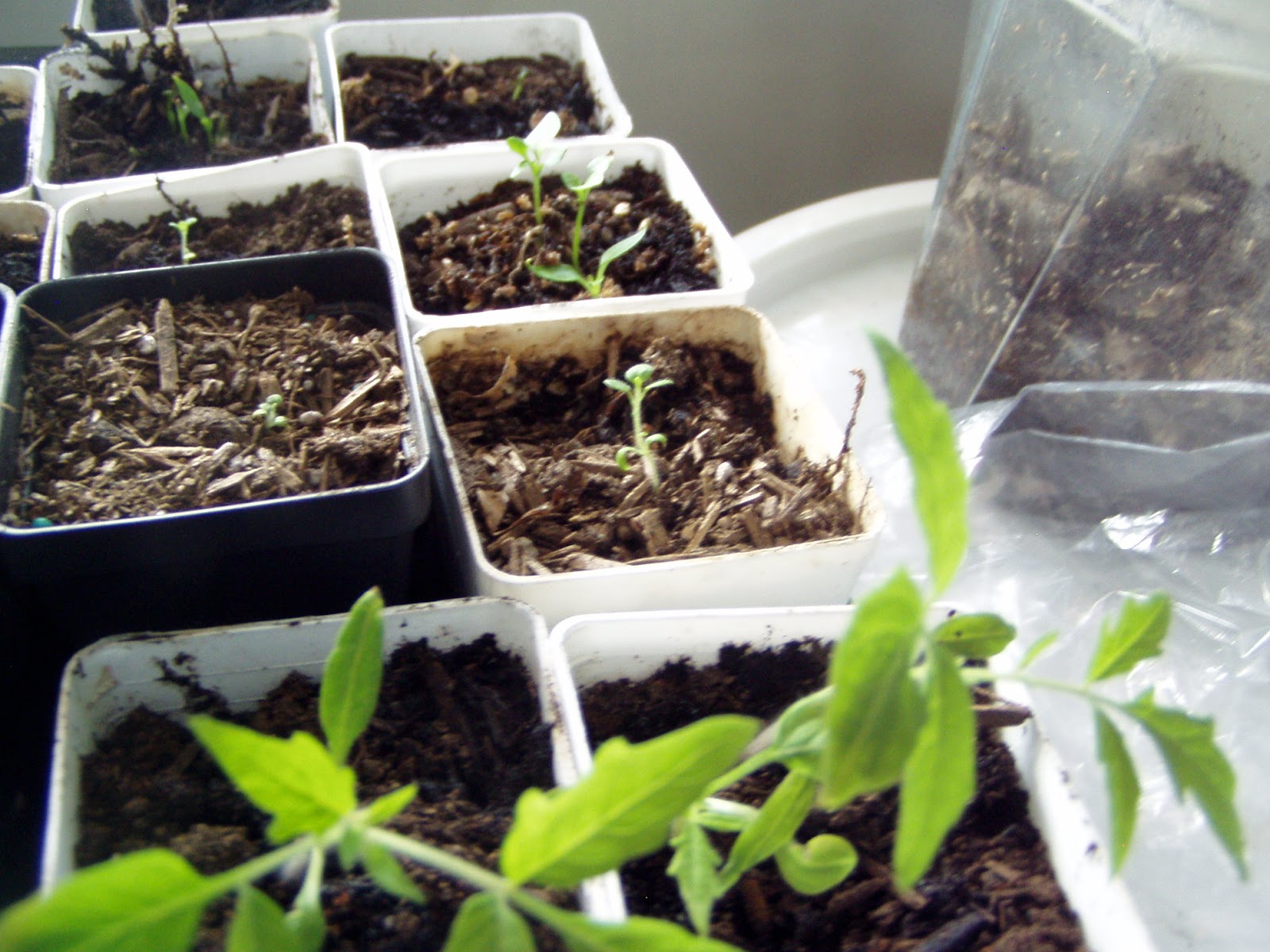
The potato seedling is shown here (in the center) with tomatoes below and peppers above, all of them planted the same day. If you look really close you can see two more potato seedlings, just two leaves poking up above the soil in the two pots that look empty. This was the day after transplant into their first pots.
I'm half expecting a high failure rate this year. I hope not, but working with plants when I'm not familiar with their habits and needs gets tricky.
Monday, February 27, 2017
It's not "Traditional"
It snowed last night and the sky is overcast. Not unexpected for February. Last night I was chortling over the new snow, but this morning I want to go out and play in the dirt, and it's all covered with sky dandruff! :)
It's interesting how habits affect people. I was talking about the garden the other day and the man I was talking to asked how I was going to till 18 inches of mulch into the soil. I said I wasn't going to till and started to explain, but I got as far as "no-till" and he said "Maybe that's why you're not getting a crop. The soil needs to be tilled or nothing will grow."
We get a good crop every year (aside from corn, which is another topic altogether) but that doesn't seem to matter. If we're not tilling, we're not getting a crop. Habits.
Tilling has been a staple of gardening and/or farming for generations. It allowed for "commercial" farming rather than a group of people walking through the fields poking holes in the dirt. It allowed an easily harvestable crop, in straight rows, so it was more economically feasible, and over time it became an inflexible rule--no till, no crop.
It's not precisely true. Or not at all true, depending on your point of view. Tilling breaks up the soil, allows water to escape, allows air into deep soil where it would not normally be and jumpstarts the bacterial process that releases a short-lived nutrient payload into the soil. There's a lot of science surrounding the issue, but tilling is traditional and speaking against it is Badthink.
Then there's monocropping--planting a single type of plant in blocks, in straight rows. Again, a carryover from commercial farming.
Another long-lived gardening "habit" is leaving the space around trees open, the soil uncovered to prevent rot, disease, and keep rodents and bugs away. But nature doesn't work that way. The leaves fall, surround the tree, form an extra layer of winter protection, keep water IN the soil, prevent bugs and provide (through compost) an extra influx of nutrients every year. It's really not rocket science. And yet I talk to people all the time who are of the "bare dirt" philosophy.
I normally just smile and keep my mouth shut. The bare-dirt philosophy started because commercial farmers needed clear space under their trees for harvest and care of the trees. Over time it hardened into an inflexible rule. If you allow anything to fall or grow under your trees your trees will die.
Traditions and habits can be a good thing. They teach the basics, prevent many problems, and otherwise form a framework for a life. But as adults we need to THINK beyond the traditions. Honestly, with most things I end up going with the habits or traditions, but it's because I've identified the issue, thought it through, and decided that the habit or tradition is the best way to go.
Blind adherence is not my way. But if I try something new in my garden and find out it doesn't work I'm willing to go back to the traditional. Or at least to consider it. :)
Sunday, February 19, 2017
Best laid plans
My process for everything = as little effort as possible and no outside resources that might not be available at some point. That includes electricity, which makes people look at me oddly and wonder about my sanity. To which I can only reply that if they knew me they wouldn't have to wonder.
I look through gardening catalogs and I see special starting trays, heat mats, specialized starting medium, even coated seeds so they germinate more easily and predictably. The gardener's perfect setup to ensure success every time! My own "setup" consists of a covered cake tray, toilet paper rolls and sphegnum moss. Whoop-de-doo. Severely high-tech, do NOT try this at home. :)
I cut the toilet paper rolls in half, stuff them with moss, put them inside the cake tray, hydrate the whole thing, plant the seeds and done. Well not technically DONE, but done with that piece. In a sunny southern window the seeds get plenty of heat--sometimes too much.
But someday, those resources may not be available and I want my plants to survive and continue to feed me. With that in mind, I want strong, self-sufficient monsters that are going to survive no matter what is thrown at them, and that won't happen if I coddle them with all the stuff that people seem to think is necessary. So when a seedling starts to sag from damping off, I pull it. If one comes up with no seed leaves, I pull it. I don't spend time and resources on trying to save something that will just pass on weakened genes to the next generation.
Up to this point I haven't taken this beyond seedlings, but this year will be different--if I can make myself pull perfectly healthy plants just because they get a virus or a calcium deficiency. I don't want those weaknesses in my seeds. If there is no fertilizer I don't want plants that have grown into that dependency over a matter of generations.
So starting this year I'm going to be ruthless. I hope. At least that's the plan.
Sunday, February 12, 2017
Seedling update
True potato seeds (TPS) had about a 30% germination rate, which is fine because I only want the strongest plants to put outside. I'll be doing the next batch with brighter lights to see how that affects it. I was initially told to use supplemental lighting and bottom heat but I don't really have any way to do bottom heat without electricity so that's a no. Once this set is well established I'll be doing at least one more this year, then save the rest of the seeds.
Tomatoes had an excellent germination rate, which they usually do--all my own self-harvested seeds. Three of the pots had only one plant come up, but several had 3 so we ended up with 30 strong plants. I planted 32. One damped off so I pulled it. Only the strongest are going in the ground this year, and I've half decided (well, 3/4 decided) to pull any that have blossom end rot.
Last years peppers were a wash. Only a few came up and they didn't have seed leaves. I ended up with one after planting about 30. I assumed something was wrong with the seeds so this year I just pretty much dumped the seeds--anywhere between three and ten in each pot. It looks like most came up. I have 18 for sure, possibly another 10 or 12 coming.
Celery was a wash. Not a single seedling. I'm going to replant with brighter lights and see if that helps.
One licorice plant sprouted. I planted additional seeds to see if we can get more. Ideally one for each fruit tree (as nitrogen fixers), but if we can get one established we're home free.
No sign of fruit tree seedlings yet, but I don't expect that until later. Possibly as late as May.
One goumi survived the winter.
Last night's frost melted off in minutes. Another month before I can safely (!) plant out the tomatoes with protection. I did it last year in February and they thrived, but the other plants caught up and they didn't fruit any sooner so the extra work and care isn't worth it.
Wednesday, February 1, 2017
Projects
As spring gets closer I start dancing anxiously, wanting to be out there playing in the dirt. I look out my window and I see the grapevines that need to be trimmed, the trees that need to be pruned, my garden area (now covered with a six inch layer of leaves for mulch!) and my fledgling forest garden.
The forest garden was last year's major project. Everything up there will be perennials or self-seeding annuals, and I mulched it heavily this year so hopefully I won't need to water as much. The tree I have right now is a rescued apricot. I need two dwarf cherry trees to finish the "canopy" layer, but for the understory I have akebia, gooseberry, currants and aronia. Akebia is a vine, which eventually will create a windbreak for the strong winter winds. I also have edible honeysuckle that I grew last year, but I don't know if it survived the winter. At groundlevel I planted potatoes, herbs, strawberries, horseradish and kale along with various scattered annual seeds. This year I'll leave it mostly alone so the plants can fight out their own balance and naturalize wherever they fit best.
As I said, last year I covered the gardens with a thick layer of leaves for mulch. The plan is to use the fall leaves from the trees to cover whatever area is lying fallow the following year, giving the leaves a year and two winters to compost. If there are sufficient leaves (or I can get enough) I'll finish a new garden area each year. Every area of the garden will get a thick layer of mulch at least every seven to ten years rather than a scattering of leaves every year.
I have two major projects planned for this year. The first is the greenhouse. The roof will be a watershed, directing the water from runoff into the forest garden. During the summer it will be covered with vines for temperature control and it will sit flat against a block wall for heat in the winter. A combination of geothermal and sun. It will have a door on either side to allow the winds to blow directly through for another layer of temperature control.
The second major project is removing a bunch of grass and planting fruiting berries and herbs as a border around the yard. We plan to raise the ground level around the edge by about 18 inches, which will necessitate moving the sprinklers in and up as soon as the ground thaws enough. The flattening of the ground will prevent much of the runoff we currently experience and the rainspout from the roof will feed into this area as an additional water source. Since the plants I'm considering are drought tolerant or local natives (Serviceberry, lavender, etc), it shouldn't ever need supplemental water.
My minor projects are growing potatoes from true potato seed (TPS) and grafting fruit-trees onto serviceberry root-stock.
I'm anxious to get started, but the ground is still covered with white sky-dandruff. :)
Subscribe to:
Posts (Atom)